Read the neighborhood
Begin with the pattern. Finish with the site.
Shore Acres makes exposure impossible to ignore, but conditions still vary by block and yard. Open water, wind, salt spray, standing water, fill, walls and neighboring canopy can create sharply different sites. Begin with the exposure and drainage actually observed, then investigate species and forms that can mature within the available space.
Which sites can support durable shade or habitat without depending on a false promise of a storm-proof tree?
Canopy signals
What to notice on the walk.
Salt pathway
Look for direct exposure, wind corridors and leaf-edge injury; salt load varies by yard.
Drainage history
Record standing-water evidence, soil level and recovery after ordinary rain.
Wind structure
Study trunk taper, branch attachment and crown balance; species name alone does not determine resilience.
Tree shortlist
Candidates to investigate—not a shopping list.
Confirm the exact site, mature dimensions, Pinellas County distribution, current rules and nursery form before selecting a tree.
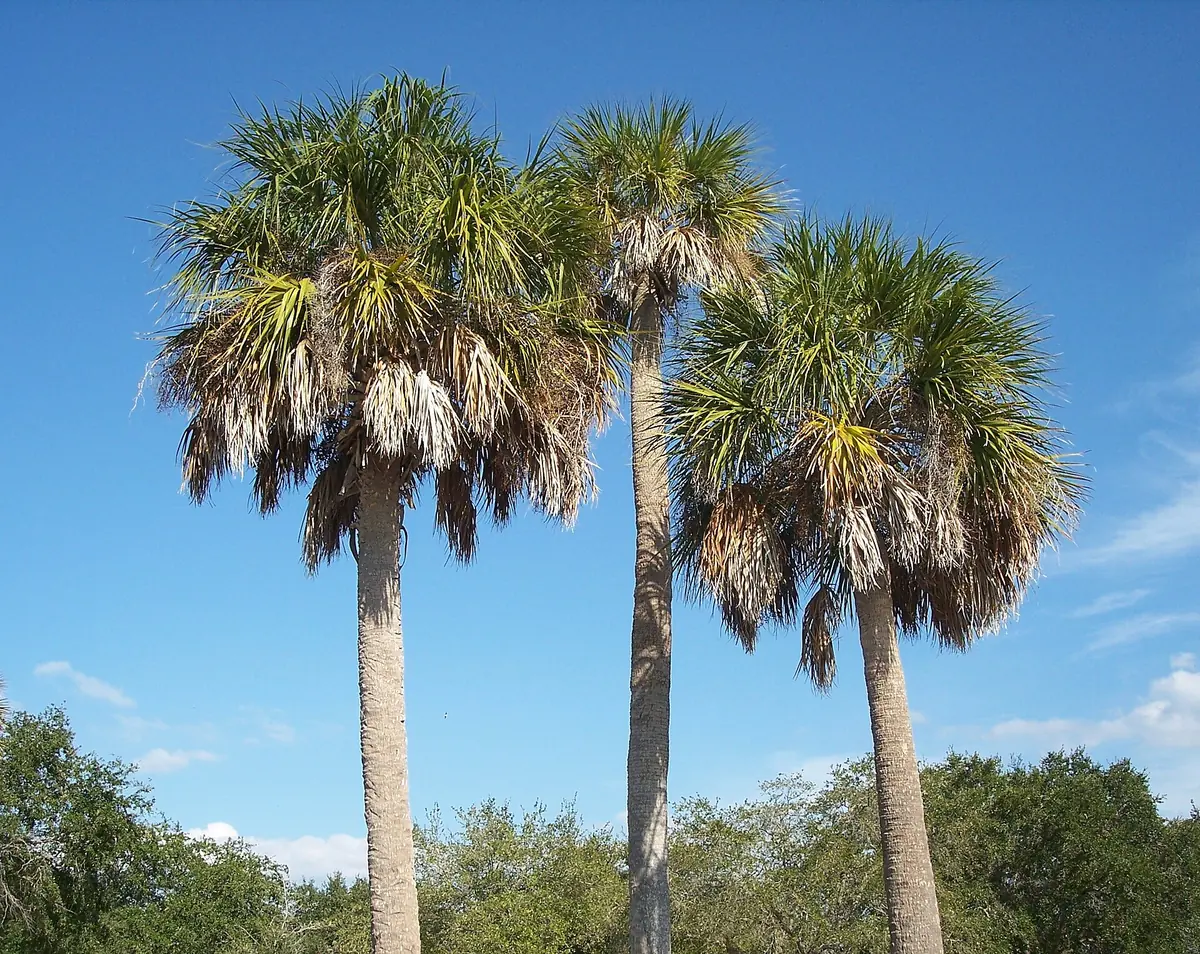
Sabal palmetto
Sabal palmetto
A native palm for many exposed sites and a strong vertical habitat layer.
Watch: Source, planting depth, salt and drainage still matter.
Quercus virginiana
Southern live oak
Broad shade where salt exposure is moderate and root and crown space are ample.
Watch: Requires room and sound structure; it is not a storm guarantee.
Myrcianthes fragrans
Simpson's stopper
A smaller native to investigate for warm, sheltered-to-moderately exposed sites.
Watch: Confirm local range, salt exposure, mature width and cold sensitivity.
Beyond the tree
Build the plant community in layers.
Exposed layer
Muhly grass / blanketflower
Investigate for bright, drained sites after checking salt and irrigation.
Sheltered shrub layer
Coontie / Simpson's stopper
Use shelter without crowding access or utilities.
Low living cover
Frogfruit / sunshine mimosa
Match moisture and salt tolerance and maintain a clear paved edge.
A 20-minute canopy walk
Take the field note outside.
- 01Start at the most exposed edge
Record wind direction, salt clues, canopy form and where shelter begins.
- 02Move behind a building or crown
Compare leaf condition, soil moisture and plant form in the sheltered microsite.
- 03Finish at a shade gap
Measure the real crown and root envelope before choosing the planting layer.
Keep reading
Guides for the yard behind the neighborhood pattern.
Use these practical field guides to translate the observations from your walk into a site-specific shortlist and planting plan.
Salt, Wind and Storm Exposure: Choosing Tampa Bay Trees
A resilience-minded checklist for exposed coastal and urban sites without making impossible storm-proof promises.
Open field guideNative Trees for Saint Petersburg Yards
A site-first guide to matching canopy, roots, soil, sun and exposure in compact coastal-city lots.
Open field guideHow to Plant a Florida Native Tree for Long-Term Establishment
A calm, repeatable planting sequence: root flare, wide hole, mulch, water and early structural care.
Open field guideSources and map references
- City of St. Petersburg GIS - Neighborhood Associations
- City of St. Petersburg - 2022 Tree Canopy Analysis
- Florida Native Plant Society - Native plant finder
- UF/IFAS - Urban tree site evaluation and species selection
This page describes a field-observation framework. It is not a parcel-level inventory, landscape plan or substitute for current municipal guidance.