Read the neighborhood
Begin with the pattern. Finish with the site.
Historic Old Northeast rewards a block-by-block reading. Mature crowns can make one street feel deeply shaded while the next has a younger or more interrupted canopy. Nearer the water, wind and salt spray may matter more; farther inland, pavement, utilities and tight planting strips can become the sharper constraint.
Where can the next generation of shade grow to maturity without repeating a conflict with wires, paving or a house?
Canopy signals
What to notice on the walk.
Canopy continuity
Notice whether neighboring crowns overlap across the street or stop at driveways, utility corridors and recently rebuilt lots.
Bay exposure
Compare leaf condition and plant form on open east-facing edges with more sheltered interior blocks.
Rooting room
Look for lifted paving, narrow verge strips and trunks squeezed between hard surfaces before assuming another large tree will fit.
Tree shortlist
Candidates to investigate—not a shopping list.
Confirm the exact site, mature dimensions, Pinellas County distribution, current rules and nursery form before selecting a tree.
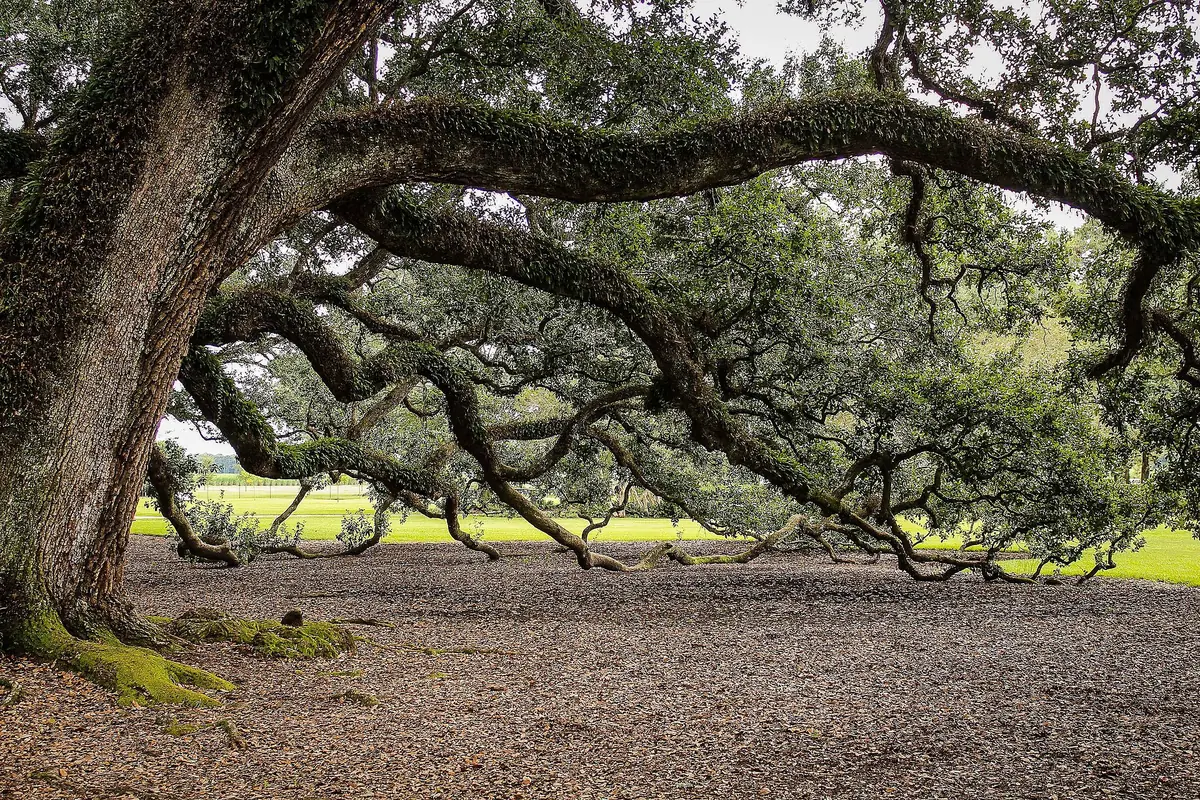
Quercus virginiana
Southern live oak
Long-lived, broad neighborhood canopy where there is generous soil and crown space.
Watch: Too large for a narrow strip; surface roots and pavement conflict need room from the start.
Sabal palmetto
Sabal palmetto
Native vertical layer for exposed sites and Florida character.
Watch: Useful in the right site, but not a one-for-one substitute for shade canopy.
Ilex vomitoria
Yaupon holly
A smaller native tree or large shrub for constrained residential spaces.
Watch: Confirm mature form, fruiting preference and exact light and moisture conditions.
Beyond the tree
Build the plant community in layers.
Understory structure
Coontie / beautyberry
Use beneath light canopy or at edges where their final width will not block walks and sight lines.
Sun-and-wind layer
Muhly grass / blanketflower
Good candidates for bright, well-drained areas; confirm irrigation and salt exposure for the exact site.
Low living cover
Sunshine mimosa / frogfruit
Consider where low plants can reduce bare soil without spilling into a public walkway.
A 20-minute canopy walk
Take the field note outside.
- 01Begin under a complete canopy
Record shade, crown overlap, trunk spacing and the amount of unpaved soil available to each tree.
- 02Turn onto a gap block
Ask what interrupted the canopy: utilities, redevelopment, a narrow verge, storm loss or simply a younger planting cycle.
- 03Finish toward the bay
Look for changes in wind exposure, leaf texture and planting form. Treat these as observations, not a substitute for testing the actual yard.
Keep reading
Guides for the yard behind the neighborhood pattern.
Use these practical field guides to translate the observations from your walk into a site-specific shortlist and planting plan.
Live Oak, Gumbo Limbo or Southern Magnolia for a Florida Yard?
A side-by-side way to compare three distinctive trees by mature space, exposure, roots and regional fit.
Open field guideNative Trees for Saint Petersburg Yards
A site-first guide to matching canopy, roots, soil, sun and exposure in compact coastal-city lots.
Open field guideA Seasonal Tree Calendar for West-Central Florida Yards
What to observe, plan and maintain through the dry season, rainy season and storm season.
Open field guideSources and map references
- City of St. Petersburg GIS - Neighborhood Associations
- City of St. Petersburg - 2022 Tree Canopy Analysis
- Florida Native Plant Society - Native plant finder
- UF/IFAS - Urban tree site evaluation and species selection
This page describes a field-observation framework. It is not a parcel-level inventory, landscape plan or substitute for current municipal guidance.