Read the neighborhood
Begin with the pattern. Finish with the site.
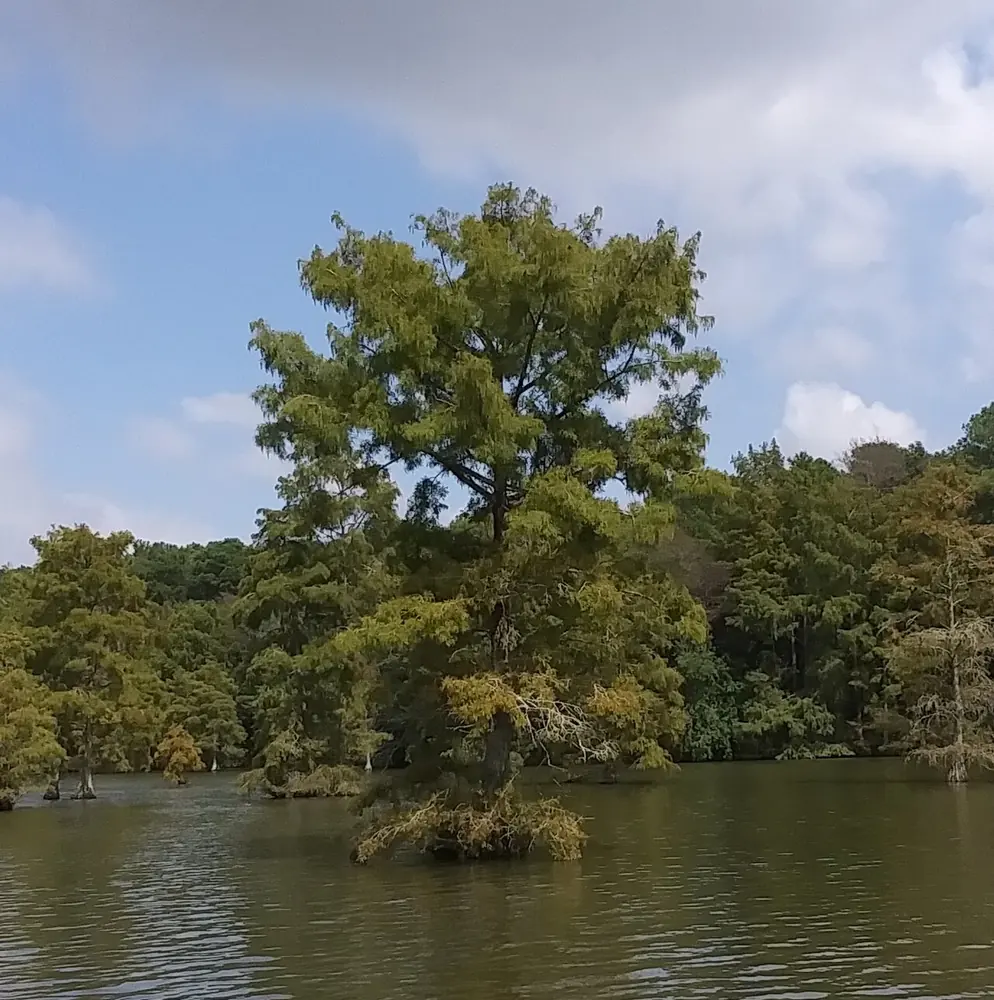
Crescent Lake makes water and landform part of the canopy conversation. The public lake-and-park edge can support conditions unlike a nearby raised residential lot. Watch how tree form, ground vegetation and soil moisture change as a walk moves away from the water.
How does the wet-to-dry gradient change which trees and plant layers can thrive without excessive irrigation or drainage intervention?
Canopy signals
What to notice on the walk.
Moisture gradient
Observe low areas, shoreward soils and higher residential ground after rain rather than assuming the whole neighborhood is a wet site.
Park-to-yard scale
A tree with room in open public landscape may be entirely wrong beside a house, sidewalk or driveway.
Canopy edges
Look where broad shade meets full sun; these transitions can support different understory and ground-layer communities.
Tree shortlist
Candidates to investigate—not a shopping list.
Confirm the exact site, mature dimensions, Pinellas County distribution, current rules and nursery form before selecting a tree.
Taxodium distichum
Bald cypress
A distinctive large native for appropriate moist or seasonally wet sites with room to mature.
Watch: Its scale, roots and moisture context make it unsuitable for many small residential spaces.
Magnolia virginiana
Sweetbay magnolia
A native tree to investigate for moist, organically richer sites and layered habitat.
Watch: Confirm local range, drainage, mature dimensions and nursery form before selecting.
Sabal palmetto
Sabal palmetto
A native vertical accent across a range of Florida landscape conditions.
Watch: Match the source and planting site; palms provide a different canopy function from broadleaf shade trees.
Beyond the tree
Build the plant community in layers.
Moist-edge layer
Blue flag iris / swamp sunflower
Investigate only for genuinely moist sites; avoid moving plants from the wild or modifying public shorelines.
Canopy-edge layer
Beautyberry / muhly grass
Use where the light transition and mature width suit the path, yard or garden edge.
Drier ground layer
Frogfruit / sunshine mimosa
Consider in sunny, drained areas where an intentional low cover is wanted.
A 20-minute canopy walk
Take the field note outside.
- 01Start at the open-water edge
Notice wind, sun, saturated ground and species that occupy the lowest landscape positions.
- 02Cross the park canopy
Compare crown scale, shade depth and the space available around trunks and roots.
- 03Continue into residential blocks
Watch the site envelope tighten around buildings, paving and utilities; revise the tree size class accordingly.
Keep reading
Guides for the yard behind the neighborhood pattern.
Use these practical field guides to translate the observations from your walk into a site-specific shortlist and planting plan.
Native Trees for Saint Petersburg Yards
A site-first guide to matching canopy, roots, soil, sun and exposure in compact coastal-city lots.
Open field guideHow to Plant a Florida Native Tree for Long-Term Establishment
A calm, repeatable planting sequence: root flare, wide hole, mulch, water and early structural care.
Open field guideA Seasonal Tree Calendar for West-Central Florida Yards
What to observe, plan and maintain through the dry season, rainy season and storm season.
Open field guideSources and map references
- City of St. Petersburg GIS - Neighborhood Associations
- City of St. Petersburg - 2022 Tree Canopy Analysis
- Florida Native Plant Society - Native plant finder
- UF/IFAS - Urban tree site evaluation and species selection
This page describes a field-observation framework. It is not a parcel-level inventory, landscape plan or substitute for current municipal guidance.